
Master Physics
Fundamentals
From Newton’s laws to quantum mechanics — clear explanations, interactive calculators, and expert guides designed to build lasting physics understanding.
Explore Categories
View All →Physics Core Concepts
Core physics principles, formulas, study guides, motion laws, and problem-solving concepts.
View All →Waves & Optics
Wave motion, light behavior, reflection, refraction, diffraction, and optical physics concepts.
View All →Electricity & Magnetism
Electric fields, circuits, magnetic forces, electromagnetism, and current flow fundamentals.
View All →Thermodynamics
Heat transfer, entropy, thermal energy, temperature laws, and energy conservation principles.
View All →Physics Tools & Calculators
This Week’s Featured Article
Physics Fundamentals: The Complete Guide to Understanding How the Universe Works
Physics explains force, matter, gravity, energy, and motion through scientific laws that shape every physical process in the universe.
Understanding mechanics, waves, thermodynamics, and electromagnetism builds real scientific intuition beyond memorising equations.
What You’ll Learn in This Article
- Newton’s Laws of Motion
- Conservation of Energy
- Wave Motion & Interference
- Thermodynamics & Entropy
- Electromagnetism Fundamentals
- Quantum Mechanics Basics
- Einstein’s Relativity
- Gravity & Black Holes
- The Expert Guide to Physics Fundamentals Worth Knowing
 Physics Fundamentals Physics — the scientific study of the universe — connects fundamental concepts like motion, force, and … Read more
 - The Practical Guide to Physics Formula Sheet You Can Use Today
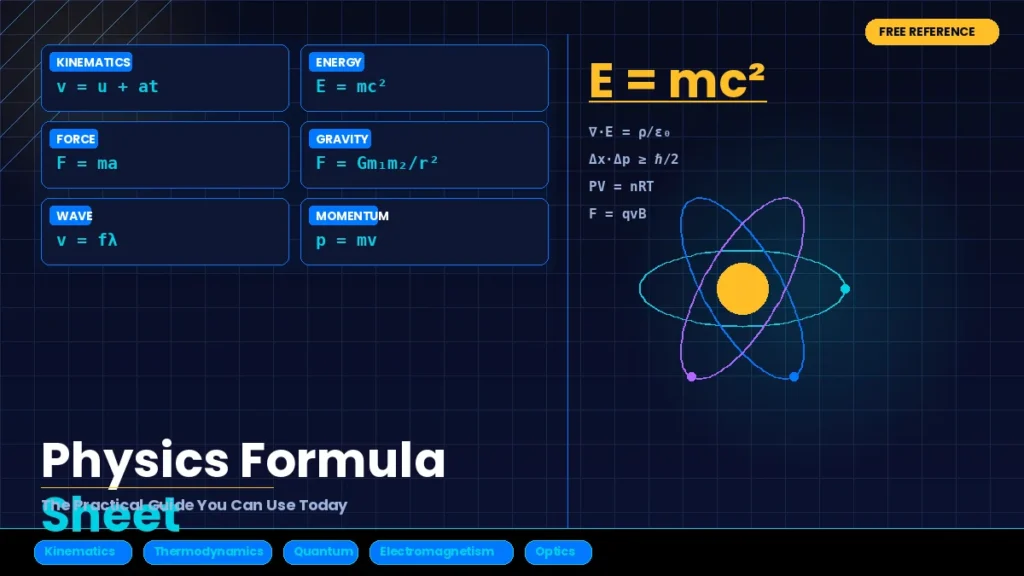 Introduction A physics formula sheet serves as far more than a mere reference guide; it is a precisely … Read more
 - A Level Physics Notes Complete Guide: All You Need to Know
 Introduction Not every material fails the same way. Brittle substances snap without warning, while ductile ones stretch considerably. … Read more
 - The Powerful Guide to Newton’s Second Law That Actually Work
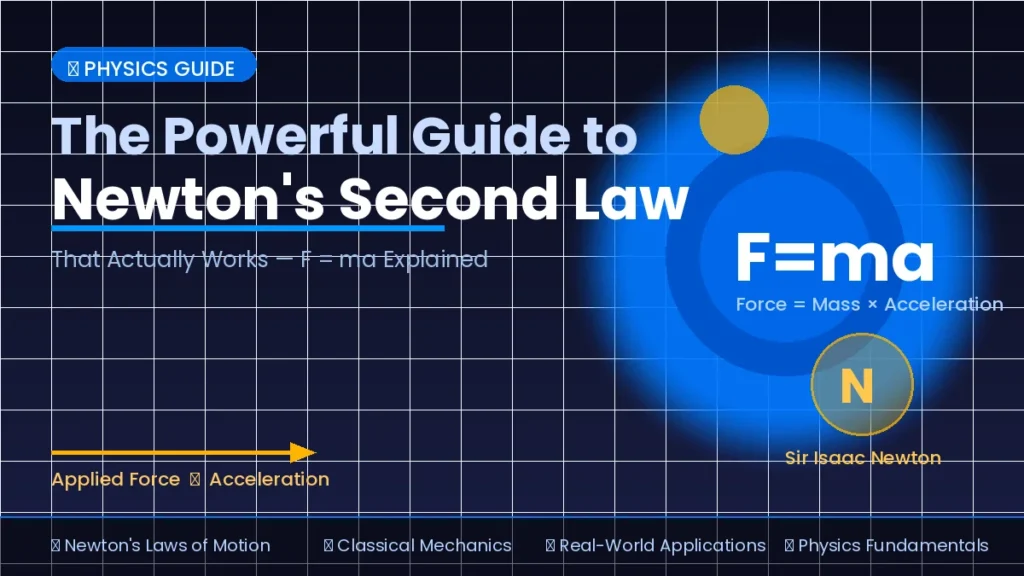 INTRODUCTIONS Few principles in physics carry the weight that Newton’s second law does. Every motion you witness—from a … Read more
Physics Fundamentals FAQ
What are the main branches of physics?
The major branches include classical mechanics, electromagnetism, thermodynamics, quantum mechanics, and relativity.
What is the most important physics law?
Conservation of energy is one of the most universal laws because energy can change form but cannot be created or destroyed.
How does quantum mechanics differ from classical physics?
Classical physics explains large objects, while quantum mechanics explains particles at atomic and subatomic levels.
What does E=mc² actually mean?
Einstein’s equation shows that mass and energy are connected, and a small amount of mass can convert into a large amount of energy.
Why do we study physics fundamentals?
Physics fundamentals help explain motion, energy, gravity, electricity, waves, and the basic working of the universe.
Is physics relevant to everyday life?
Yes. Smartphones, cars, Wi-Fi, medical scans, engines, and electricity all depend on physics principles.